
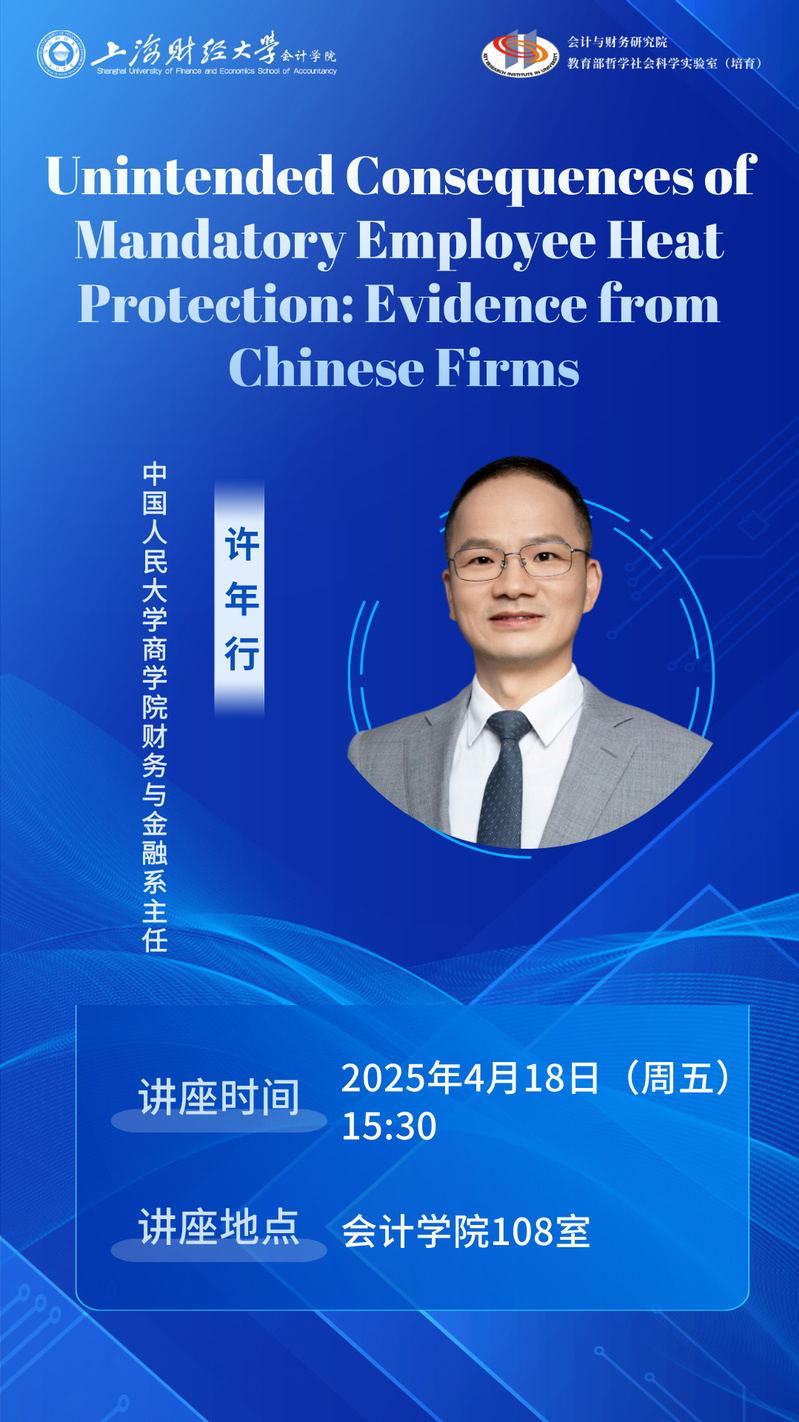
【报告主题】Unintended Consequences of Mandatory Employee Heat Protection: Evidence from Chinese Firms
【主讲嘉宾】许年行,中国人民大学商学院财务与金融系主任
【报告时间】2025年4月18日 15:30
【报告地点】会计学院108室
【内容提要】
Leveraging exogenous upgrades of outdoor workers’ heat protection policies in 2010 and 2012 in a large Chinese city, our research tests whether employers take strategic responses to mitigate or even offset the increase of human capital cost and, thus, harm the welfare of employees. Using a micro-level employer-employee matched panel database with the annual total income information covering over three million workers between 2008 and 2014, and applying a differences-in-differences approach, we find that: (1) Despite the policy raising the heat protection allowance standard twice for employees, the affected employers decreased the employees’ total compensation by approximately 3%, especially for low-income and male employees. (2) Following the requirement of prohibiting overtime outdoor work under extreme heat, the affected employers decreased employment by approximately 4%. Both findings concentrate on private firms rather than state-owned firms, suggesting revenue-oriented incentives are behind the strategic responses of employers. The results remain robust after applying a series of alternative definitions of treatment firms using firm-name-based Chat-GPT textual analysis and after expanding the single-city employee-level analysis to muti-city firm-level analysis by covering eight provinces between 2009 and 2016. Further analysis suggests that advanced governance environment can help mitigate the negative policy impacts. Overall, our findings shed light on the unintended consequences of mandatory employee protection and highlight the challenge of labor protection in the background of global warming.